

 Tweet
Tweet
This one made me think of the Zephyr Trains. Thanks for looking.
-
-
OMG Larry J, I can see why! LOL... looks like a long skid mark before the train finally stopped! Really cool LAM find! Congrats!
thank you for the laughs! i have not laughed enough today
-
Nice Zephyr The lamination may extend all the way to the east rim... There appears to be a line running from the top of the lam, at the chin, due east and it looks to be bubbled up, for lack of a better word... By the way I book marked the link you posted, love those trains, planes and auto mobiles!!!
Jim
The lamination may extend all the way to the east rim... There appears to be a line running from the top of the lam, at the chin, due east and it looks to be bubbled up, for lack of a better word... By the way I book marked the link you posted, love those trains, planes and auto mobiles!!!
Jim
(A.K.A. Elmer Fudd) Be verwy verwy quiet... I'm hunting coins!!! Good Hunting!!!
Comment
-
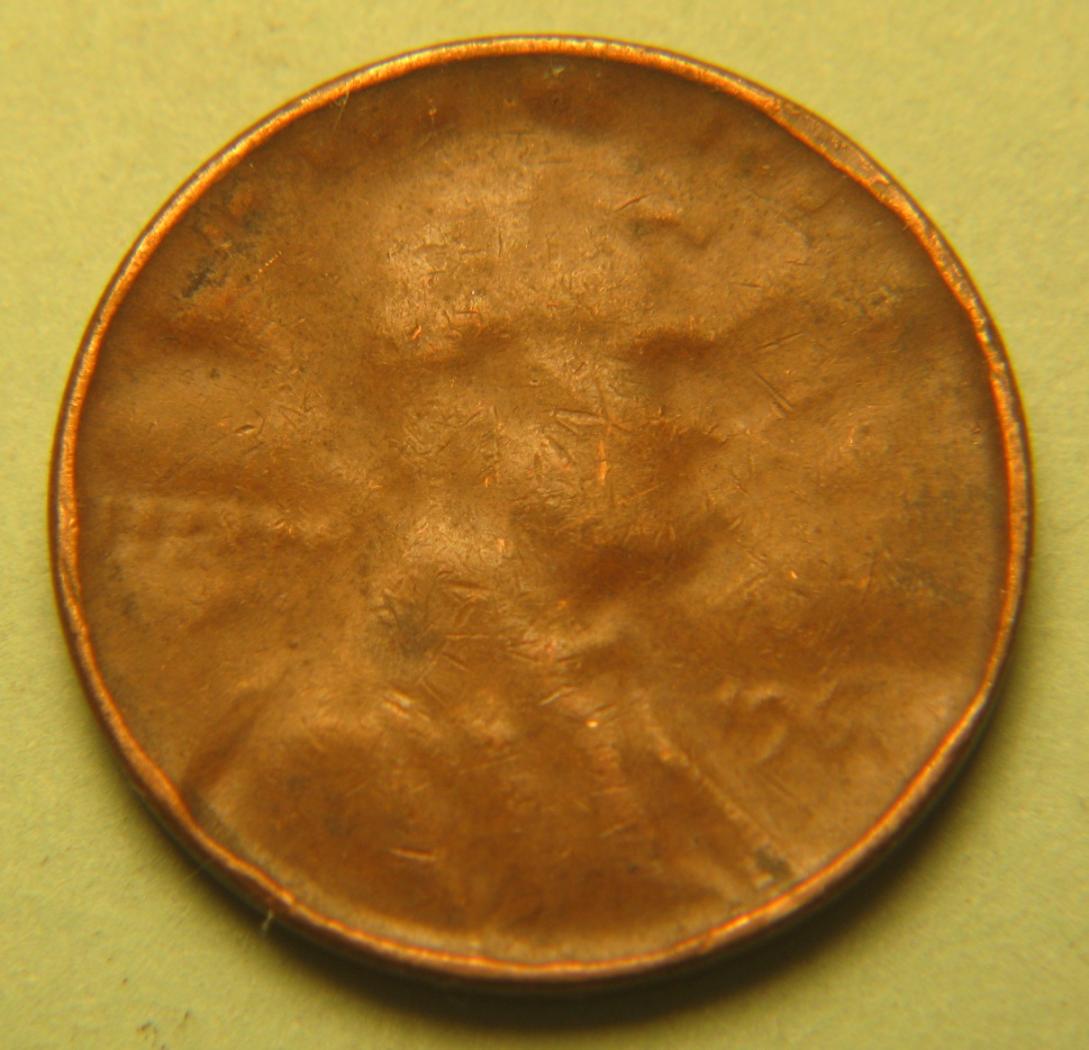
So is this just a lamination error? It looks like a struck through with lamination occurring at the edges of a struck through.Comment
-
All depends on your definition of off Here are some definitions with images of 2 different types of strike thrus from the Glossary -
Struck Through Filled Die: The most common form of struck through, a cent that is struck though a filled die will have missing or weak design elements. Since that portion of the die is filled or clogged with grease or dirt, that portion of the design will not be struck on the coin. Although this can affect any portion of a coin, some of the more well-known instances in the Lincoln series are the 1922 “Weak D” cents, as well as some of the “no FG” cents.


Struck Through Late Stage Die Cap This is a coin that was struck by a capped die which has already struck many other coins. The face of the die cap gets thinner and thinner with each strike, as it expands outward. After striking so many additional planchets, the face of the die cap will be thin enough to allow parts of the normal die design to appear on the struck planchets, yielding a ghost-like image of the bust and other devices. As the die cap continues to strike coins, more and more of the normal design elements will show on the struck coins until the die cap completely deteriorates away. Photos courtesy of forum member Joel.
My brain is not functioning at peak efficiency at this time and I am unable to explain some of the differences... Also known as a brain fart If my brain kicks back in I shall be able to help you a little better I hope!!!
Jim
(A.K.A. Elmer Fudd) Be verwy verwy quiet... I'm hunting coins!!! Good Hunting!!!Comment
-
struck through wood
This is an example of a struck through with wood. It was explained to me that a piece of wood got in between the die and the coin and creates an incise of the wood. This was what I was referring to with Larry's coinComment
-
That is cool looking... I am not 100% convinced that it is a strike thru tho but remember I am no pro... If it were a strike thru, even for wood, I wood (pun intended) not expect to see so sharp a section of the nose where it spans the suspected strike thru... What year is your coin??? I am assuming it to be a solid coin vs a clad???
Jim
(A.K.A. Elmer Fudd) Be verwy verwy quiet... I'm hunting coins!!! Good Hunting!!!Comment
-
You would most definitely much more of a pro than I will ever be! I am a novice at best and actually showing you an example I was shown by someone who new much more than me. That being said we are dealing with two different denominations, different material, clad versus solid and two totally different time periods. So my example may be irrelevant. This was an 1881 P Morgan silver dollar and it seemed to be common to have struck through coins likely because of the working conditions of the mints of the time period. With different examples I have seen, that is what Larry's coin put me in mind of. It sort of looked to have some design to the area in question, more so in my mind that just lost metal.Comment
-
Heh, heh...the wood thing went right over my head!!Comment
-
After going back and looking at the pics again I'm wondering if this isn't PSD. You can see on the west rim just under the L in LIBERTY it has been slightly pressed in.Comment
-
The area on the rim, neck and between the lower lip and lamination all appear to be PSD... That is what most likely caused the metal to displace and fall away... The lamination issues arise when the metals are mixed at the foundry... Sometimes the metal can fall out before the strike but, if memory serves me correct, most laminations with the metal missing are after strike and a lot are due to the hits received kicking the metal loose... Hope that make cents (just like my wood remark )
Jim
(A.K.A. Elmer Fudd) Be verwy verwy quiet... I'm hunting coins!!! Good Hunting!!!Comment


Comment