You are currently viewing our boards as a guest which gives you limited access to view most discussions and access our other features. By joining our community you will have access to post topics, communicate privately with other members, respond to polls, upload content and access many other special features.
For more information on registration and an upgrade to Paid and Premium Memberships go to our Membership page and join our community today!
If you have any problems with the registration process or your account login, please contact contact us.
If this is your first visit, be sure to
check out the FAQ by clicking the
link above. You may have to register
before you can post: click the register link above to proceed. To start viewing messages,
select the forum that you want to visit from the selection below.
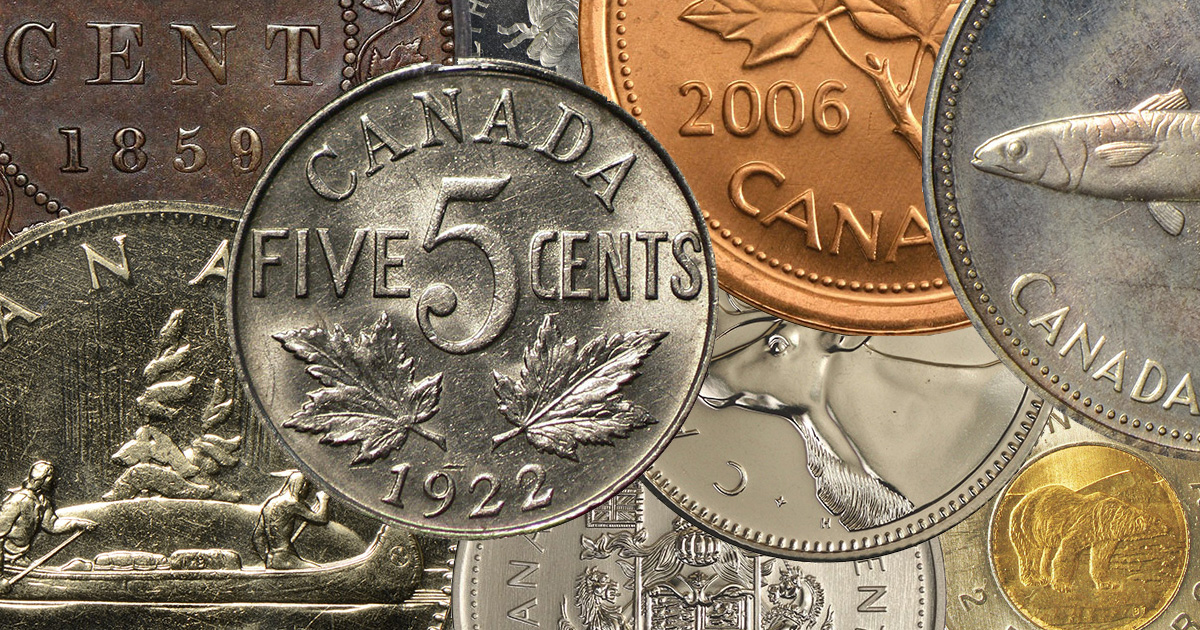
The value of a canadian coin depends on several factors such as quality and wear, supply and demand, rarity, finish and more. Values in the section are based on the market, trends, auctions and recognized books, publications and catalogs. This section also includes information on history, errors, varieties, characteristics and more.
Or do you know of a better site? I have some Canadian coins that I need to search.
“What can be asserted without evidence can also be dismissed without evidence.”
It appears to be man made but with no damage to the obv it is possibly a strike thru... Those are not lathe line unless the Canadian mint has some sort of strange wobble lathe... LOL... Cool coin none the less!!!
Jim (A.K.A. Elmer Fudd) Be verwy verwy quiet... I'm hunting coins!!! Good Hunting!!!
It has all the ear marks of being a struck through a foreign object. If the hole had been cone shaped or evenly shaped, then I would suspect some sort of drill bit or spinning tool to have made the anomaly. Without any seen damage to the obverse of the coin my thoughts turn away from post strike damage and towards an actual error.
This one's a toss-up. BJ makes some good points defending its status as a struck-through error. Also, the absence of a surrounding pressure ridge and absence of any flattening on the object argue against any kind of impact damage. At the same time, the erosion of some parts of the edge of the depression argue for mechanical removal of metal. Is there any reduction in weight relative to a normal cent of the same composition?
To me it looks like someone tried to drill a hole in it. I hate to admit it but I have tried drilling though a penny before to make a washer. it looks like the bit made a quarter turn then caught that's why it's not round. In my experience with metal working when a bit grabs and either spins the piece you are drilling or the bit grabs and stalls out the drill it will leave a similar mark. I know your going to say "there are no marks on the obverse so it cant be a drill" but if the drill had a low battery and a sharp bit it would have cut in grabbed and then bogged down the drill. What does the rim look like? It could have been held by the rim.
Guys on my fourth picture, you will notice a piece of metal gathered. Would this help indicate whether it is man made or mint made?
From my digital kitchen scale, it weighs 3 grams. I cannot read ounces. So a 1937 and this 1974 both weigh in at 3grams. Sorry for that not being much help in deducting outlining possibilities.
Looking at the coin, And the 4th pic,mainly. You can see the metal build up, and the whole thing looks 3 sided, with about 120 degrees between the three widest parts of the area in question. As a plumber by trade, i have drilled through plenty of metal, and this does look like what i would expect too see from a dull bit, I'm leaning toward PSD.
I'm going with drill bit, too. I believe the odd shape to be the result of the higher points of the coin being cut prior to the bit reaching those lower points.

 Tweet
Tweet

 Be verwy verwy quiet... I'm hunting coins!!!


Comment