You are currently viewing our boards as a guest which gives you limited access to view most discussions and access our other features. By joining our community you will have access to post topics, communicate privately with other members, respond to polls, upload content and access many other special features.
For more information on registration and an upgrade to Paid and Premium Memberships go to our Membership page and join our community today!
If you have any problems with the registration process or your account login, please contact contact us.
If this is your first visit, be sure to
check out the FAQ by clicking the
link above. You may have to register
before you can post: click the register link above to proceed. To start viewing messages,
select the forum that you want to visit from the selection below.
I thought about finally getting the microscope, but I'd have to take out a second mortgage (not on my house, but on the "Luxury Bishop" house) to buy it. So I settled on using cheap software...Ray
Builder of Custom Coin Photography Setups. PM me with your needs or visit http://macrocoins.com
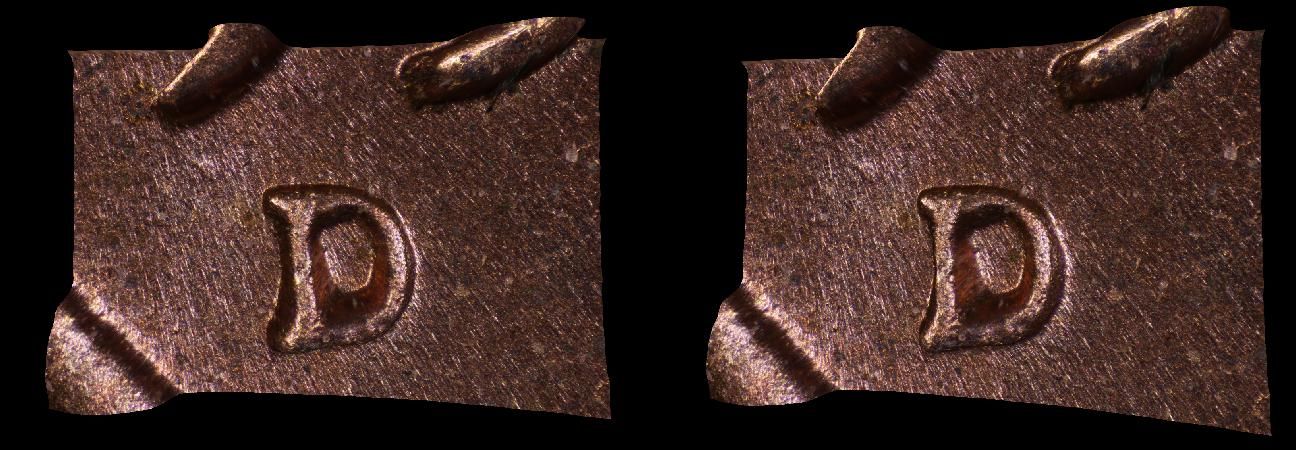
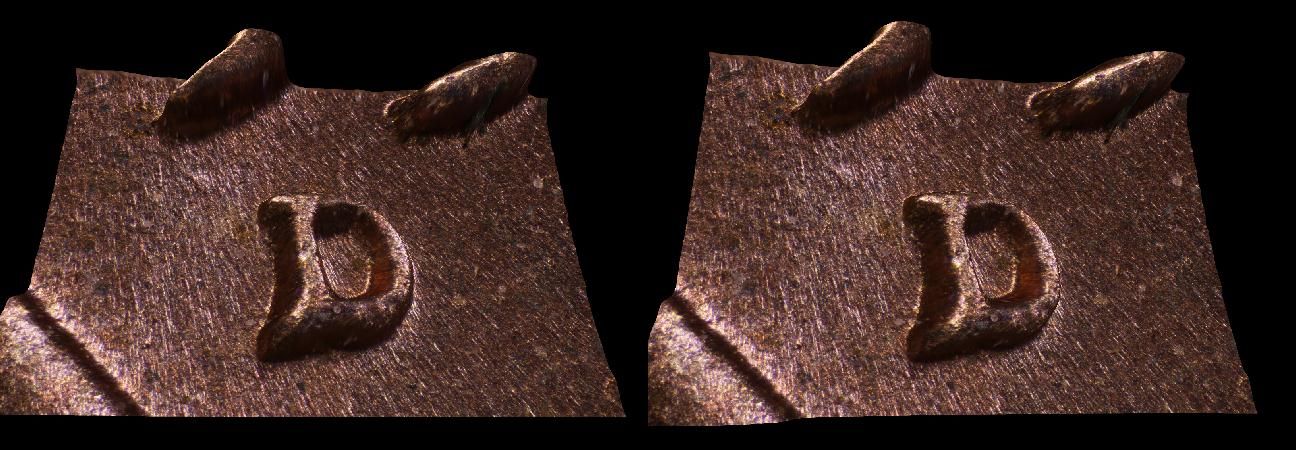
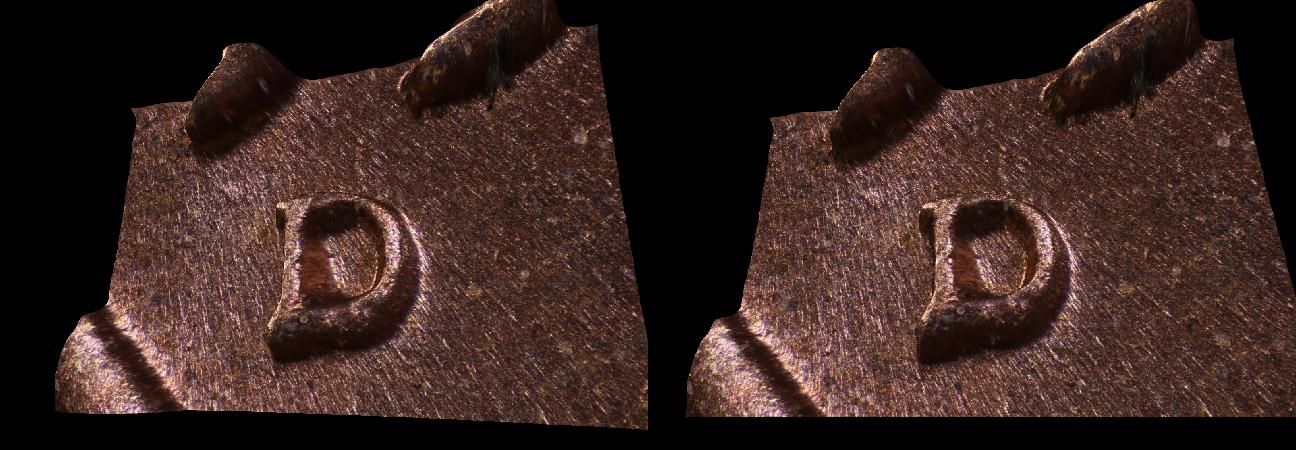
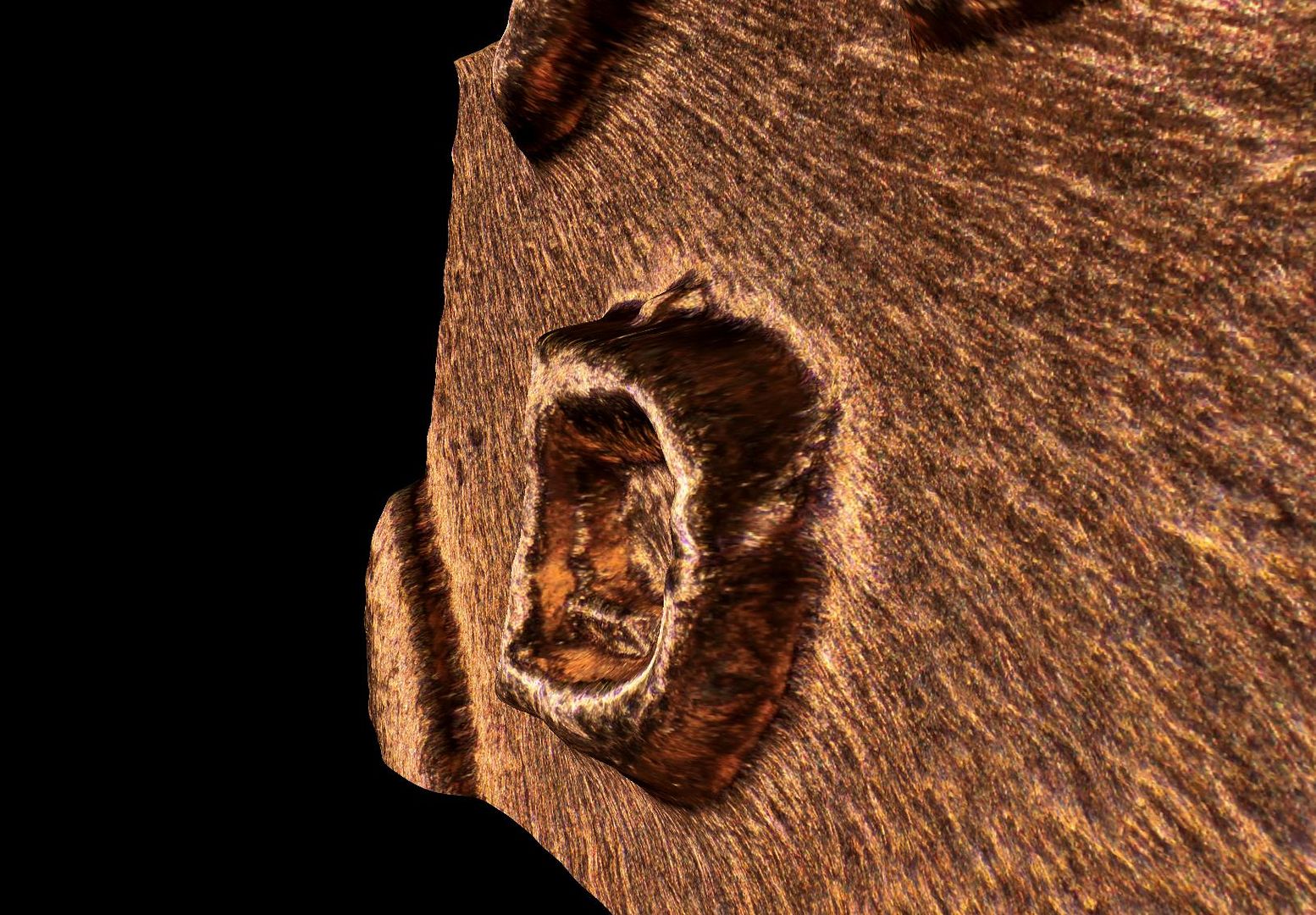
I figure the 3D stuff is a bit gimmicky, but it might actually be useful to view an RPM at high magnification from multiple angles even if the images are not in stereo. I do this when I am attributing using stereo microscope. Here are images of a BU 1956-D RPM#1 from 3:00, 6:00, 9:00, 10:00 (and magnified a bit), and 12:00.
Builder of Custom Coin Photography Setups. PM me with your needs or visit http://macrocoins.com
How accurate of a representation do you think this technique offers? Isn't information extrapolated, then interpreted to the best of the programs ability, and then rendered? For instance, the top and bottom left serifs of the D look very different to me in 3D then the original straight on non 3-D version. Curious what others think.
Interesting Ray. I suppose it could be used in the aid of diagnosing or debunking a difficult variety. But for practical purposes it doesn't seem to add much. It does remind me that it would be nice to have a VEDS representation of a few specific mintmarks that could then be sent to a 3d printer. After a little hand re-manipulation to make it a little closer, one might be able to cast the final product in something a little harder and do some RPM experiments in a soft material. The results might be helpful - or waste of time.
Well, I've never even figured out how to do overlays yet so I will leave the 3D printing to you. If you want to try something like that, let me know. I could look for a well-punched EDS coin to test the concept on, or you could send me one. Getting the CNC info to the printer might be interesting. The program I used to generate these has a 3D model export function so I'd bet that could be hacked to work with a 3D printer.
Builder of Custom Coin Photography Setups. PM me with your needs or visit http://macrocoins.com

 Tweet
Tweet




Comment