

 Tweet
Tweet
How do you spot the difference? Maybe in the sharpness of the details?
-
-
To a degree yes, many examples of an EDS show sharper details.
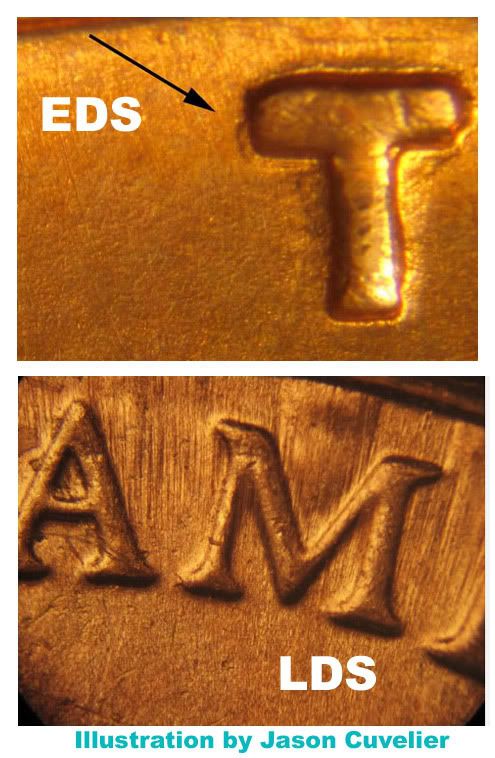
But mostly it is the examination of die flow lines in critical areas and how the devices interact with the fields. Flow lines start as little lines going toward the rims, and gradually get deeper, wider and visually appear to swallow up outside devices. It is not an easy deduction.
Critical areas are:
Around the motto
Base of Lincoln's neck
Around central devices
Other indicators such as die deterioration doubling or a heavy line through the motto (plated Lincoln cents)Last edited by jcuve; 03-07-2012, 05:18 PM.
Jason Cuvelier
MadDieClashes.com - ErrorVariety.com
TrailDies.com - Error-ref.com - Port.Cuvelier.org
CONECA
(images © Jason Cuvelier 2008-18)___________________ -
In most cases, you'd look for heavy die flow lines from the rim to the outer devices. On wheats and such, you'll notice that a lot of the LDS examples will show IGWT literally 'bleeding' into the rim, and a lot of distress and such in and around the neck/date area. All rim-laden lettering will tend to show a mushed out appearance as well. Detail to the bust is also smoothed together, and creates the effect of circulation wear (which it is not).
EDS coins, do not show any of this, unless a weak strike, grease-filled die, or some other anomaly occurs. Otherwise, all lettering and fields will be sharp and crisp, and not show any signs of distress. Elements of the coin (such as the bust) are also very crisp, and show much detail.Comment
-
Coop & Bob talk about Die states and doubling in this thread... http://www.lincolncentresource.net/f...ad.php?t=19937 post # 10 from coop shows amazing photo examples.
What's the Motto you?! Eh!Comment
-
Well I'm a VLDS - I'm doomed!
Thanks coop!
RogRoger
""Time and Tide wait for no man"Comment
-
Thanks for the help! Just to clairfy, flow lines are the straight lines connecting the outer devices (i.e: motto) with the rim, right? And to make sure I understand this stuff...they get stronger as the die state gets later and later?Comment
-
The lines are metal atoms slowly traveling from the pressure of the strike from the middle areas toward the rim. As the die goes through repeated strikes, the lines will often get deeper and the lines more apparent.
 Last edited by jcuve; 03-07-2012, 06:12 PM.
Jason Cuvelier
MadDieClashes.com - ErrorVariety.com
TrailDies.com - Error-ref.com - Port.Cuvelier.org
CONECA
(images © Jason Cuvelier 2008-18)___________________Comment
-
Well that is a simple thing to look for.
Thx JasonRoger
""Time and Tide wait for no man"Comment
Comment