You are currently viewing our boards as a guest which gives you limited access to view most discussions and access our other features. By joining our community you will have access to post topics, communicate privately with other members, respond to polls, upload content and access many other special features.
For more information on registration and an upgrade to Paid and Premium Memberships go to our Membership page and join our community today!
If you have any problems with the registration process or your account login, please contact contact us.
If this is your first visit, be sure to
check out the FAQ by clicking the
link above. You may have to register
before you can post: click the register link above to proceed. To start viewing messages,
select the forum that you want to visit from the selection below.
Pictures are too grainy to see much. What year are we working with? That makes a big difference on how to discern the problems. It looks an early LMC, which would make die cracks and machine doubling very common.
Even a fool can look wise if he keeps his mouth closed.
Sorry, I was a bit tired last night and maybe unclear. I was just curious whether these types of cracks in the casting are interesting or even valuable to other collectors.
Thanks for the follow up arrows. Cracks do get some interest.
check out this site- http://cuds-on-coins.com/lincoln-cent-idb-1959-2008/ .
Are the areas in question recessed (incuse) into the surface or raised on the surface?
Don't think so, to me it looks like it could be from glare because it's a shiny cent and in photos sometimes it causes a doubled look. There are no known reverse doubled dies for 1968 that I know of. We'll wait for the pro's to chime in.
Once again, sorry. Two different coins and issues. DD is for 1971. As for the head on that penny, the crack is not raised. I tried taking more pics but none are better than what you see. Unfortunately, I don't have a microscope. As for the DD, that's not a reflection. I can see it with magnifying glass and also with the pic. But again, that's a 71 lincoln.
Once again, sorry. Two different coins and issues. DD is for 1971. As for the head on that penny, the crack is not raised. I tried taking more pics but none are better than what you see. Unfortunately, I don't have a microscope. As for the DD, that's not a reflection. I can see it with magnifying glass and also with the pic. But again, that's a 71 lincoln.
No problem Alex, we all understand how difficult photos can be. Okay, so what we have is:
1) A 1968P with two incuse scratches, one in the hair and one near the ear. Like you said, the scratches do not appear to be raised, they are incuse. That would indicate that the coin took a hit in those areas.
2) A 1971 with what looks like doubling on the "O" of ONE which you are seeing with your loupe as well as in the pic. Sorry, I don't have a answer for this, we need the pro desk!
No problem Alex, we all understand how difficult photos can be. Okay, so what we have is:
1) A 1968P with two incuse scratches, one in the hair and one near the ear. Like you said, the scratches do not appear to be raised, they are incuse. That would indicate that the coin took a hit in those areas.
2) A 1971 with what looks like doubling on the "O" of ONE which you are seeing with your loupe as well as in the pic. Sorry, I don't have a answer for this, we need the pro desk!
When you say doubling, there is the term "double die" and another term "machine doubling." When I look at Wexler's site, this looks like double die since it isn't a step. Am I correct?
As to the incuse, they (forehead) aren't scratches. It probably doesn't show well on the forehead cracks but they are spidered cracks. IMHO that would eliminate just a casual surface scratch. It's no big deal. I tried several times to take a better shot but it will require a microscopic shot. Thanks for the feedback.
When you say doubling, there is the term "double die" and another term "machine doubling." When I look at Wexler's site, this looks like double die since it isn't a step. Am I correct?
As to the incuse, they (forehead) aren't scratches. It probably doesn't show well on the forehead cracks but they are spidered cracks. IMHO that would eliminate just a casual surface scratch. It's no big deal. I tried several times to take a better shot but it will require a microscopic shot. Thanks for the feedback.
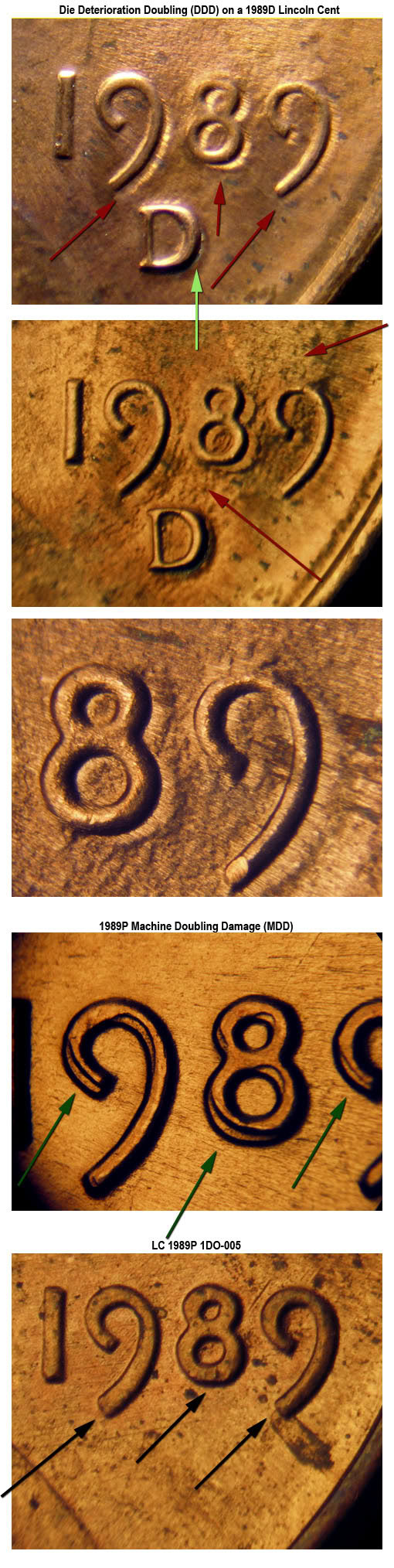
The photos are a little blurry but I will give you my opinion. There are no 1971 or 1971 D Doubled Die Reverses listed on coppercoins.com. Based on the photos I believe what you are seeing is Die Deterioration Doubling. Also the doubling looks more obvious due to the lighting. I don't believe this is a Doubled Die. Vivian called it Doubling because she didn't want to give a opinion as to exactly what it is. Thats why she said that the pro desk was needed. However I'm not a pro by any means.
Hope that helps
There are no 1971 or 1971 D Doubled Die Reverses listed on coppercoins.com. Based on the photos I believe what you are seeing is Die Deterioration Doubling
Thank you engine823, Since there are no known 1971 P or D reverse Doubled Dies, it is very highly unlikely that your coin is a doubled die. I agree that it could be Die Deterioration Doubling and probably is but we would like for one of our pros to confirm it for you so you are comfortable with the answer. Alex, here is a link to Die Deterioration Doubling and if you scroll down to the 1954-1955 you will see the more extreme example photos of DDD

 Tweet
Tweet


Comment